

The agent stack grew a toolchain
This week shipped tools, not features. SharePoint reachable through one grammar, agents deployed from the command line, and a way to test a model swap before you keep it.
Plumbing beats features
Every item below is about building agents rather than using them: a discovery grammar for SharePoint, a generally available command line, installable guidance, regression testing and a local model.
Signal of the week
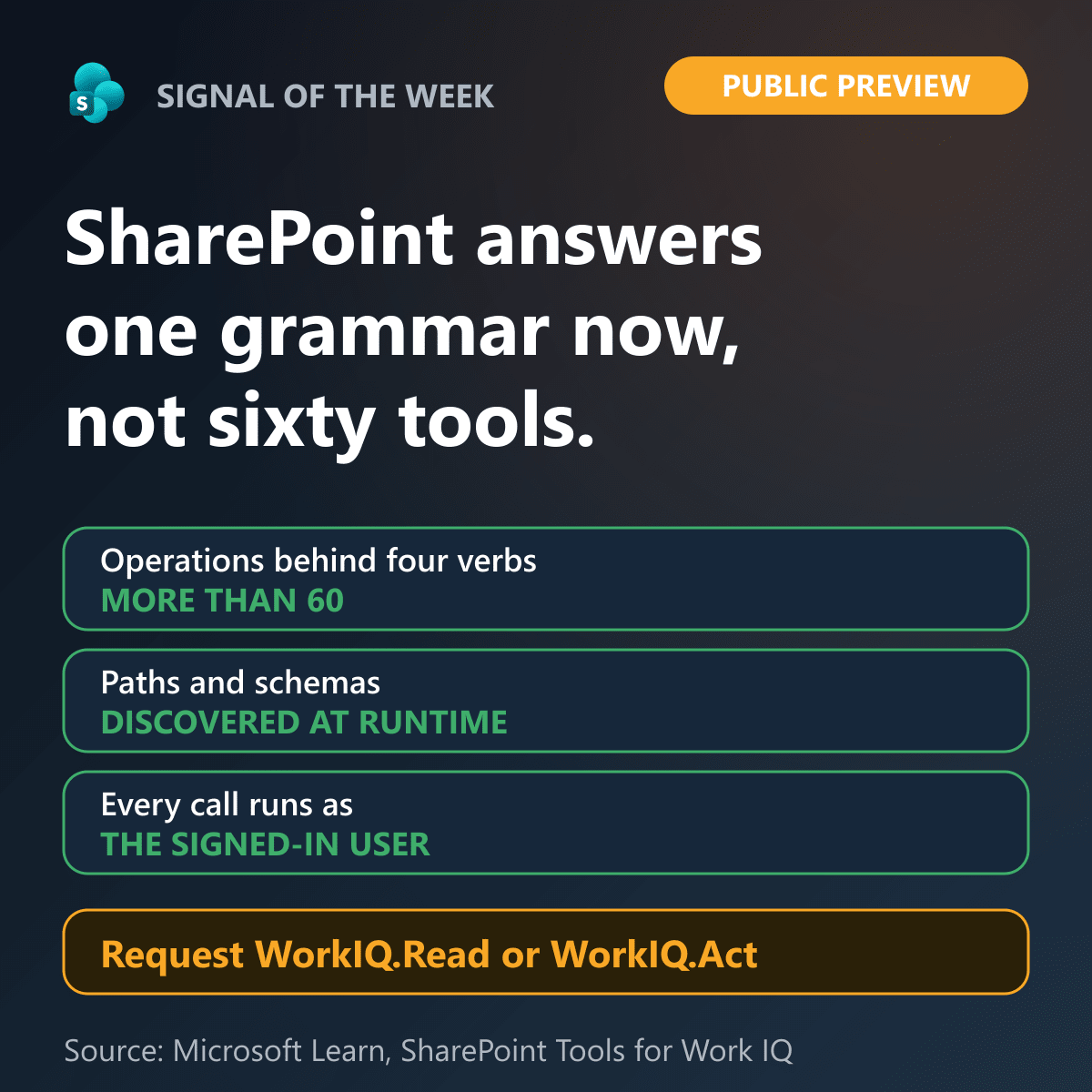
SharePoint got a grammar instead of a tool list
SharePoint tools in Work IQ are in public preview: more than 60 operations behind a handful of generic verbs. An agent calls get_site_key, then search_paths, get_schema and do_action, discovering paths at runtime instead of registering 60 separate tools. Calls run as the signed-in user. The token needs WorkIQ.Read or WorkIQ.Act; WorkIQAgent.Ask alone hides the paths entirely.
Why it matters
I have written the Graph glue for this three times, once per client. Runtime discovery keeps the tool surface small while the coverage behind it grows. I do not know yet how it behaves against a site with thousands of items.
1The command line grew up
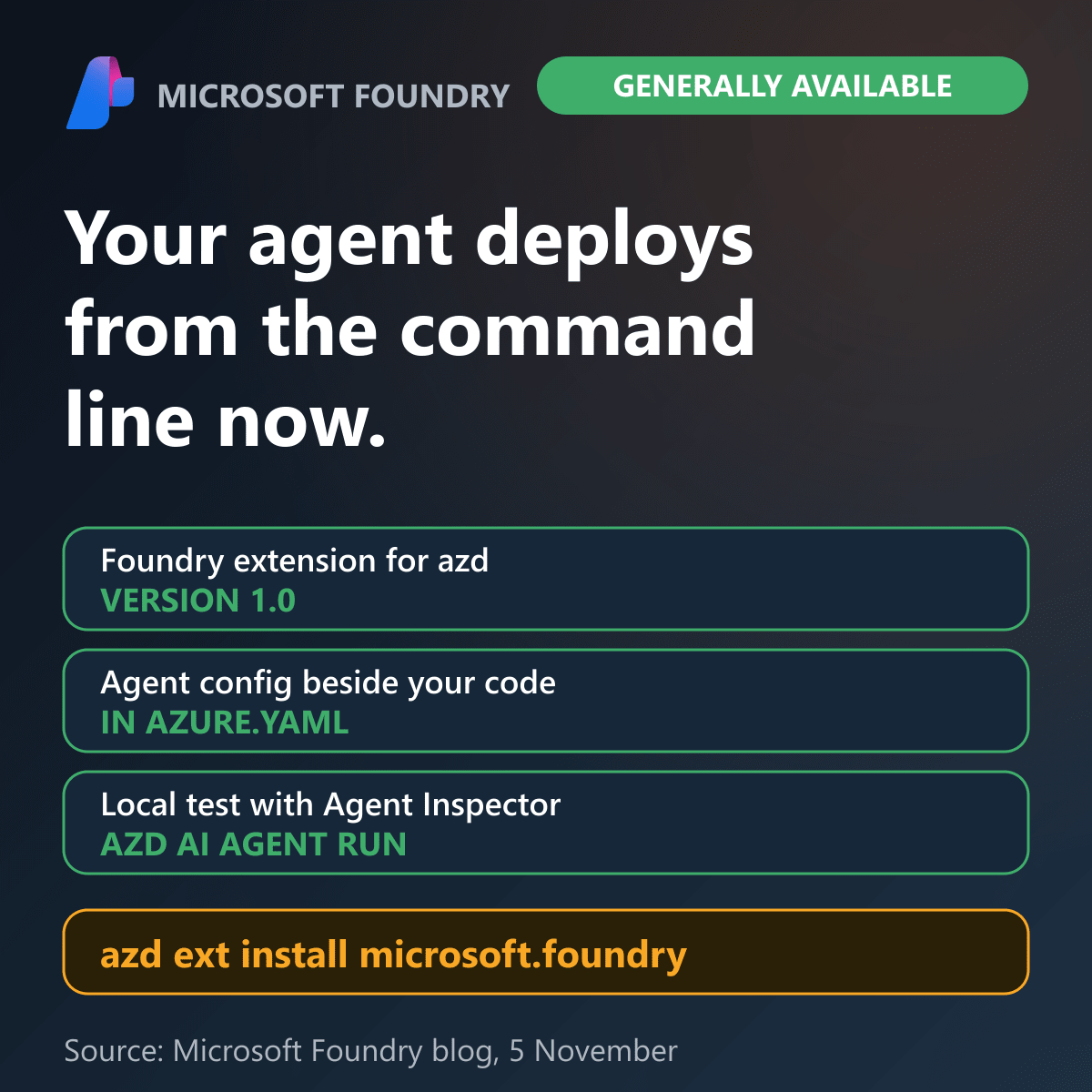
Foundry agents deploy from azd now
The Microsoft Foundry extension for the Azure Developer CLI reached version 1.0 and general availability. azd ai agent init scaffolds a hosted agent, azd provision creates the resources, azd ai agent run opens Agent Inspector against the local copy, and azd deploy uploads source for a remote build with no local container. The configuration lives in azure.yaml, beside the code.
Why it matters
Agent changes and deployment changes land in the same pull request, which is the part I have wanted since hosted agents appeared. Needs the Azure Developer CLI 1.37 or later.
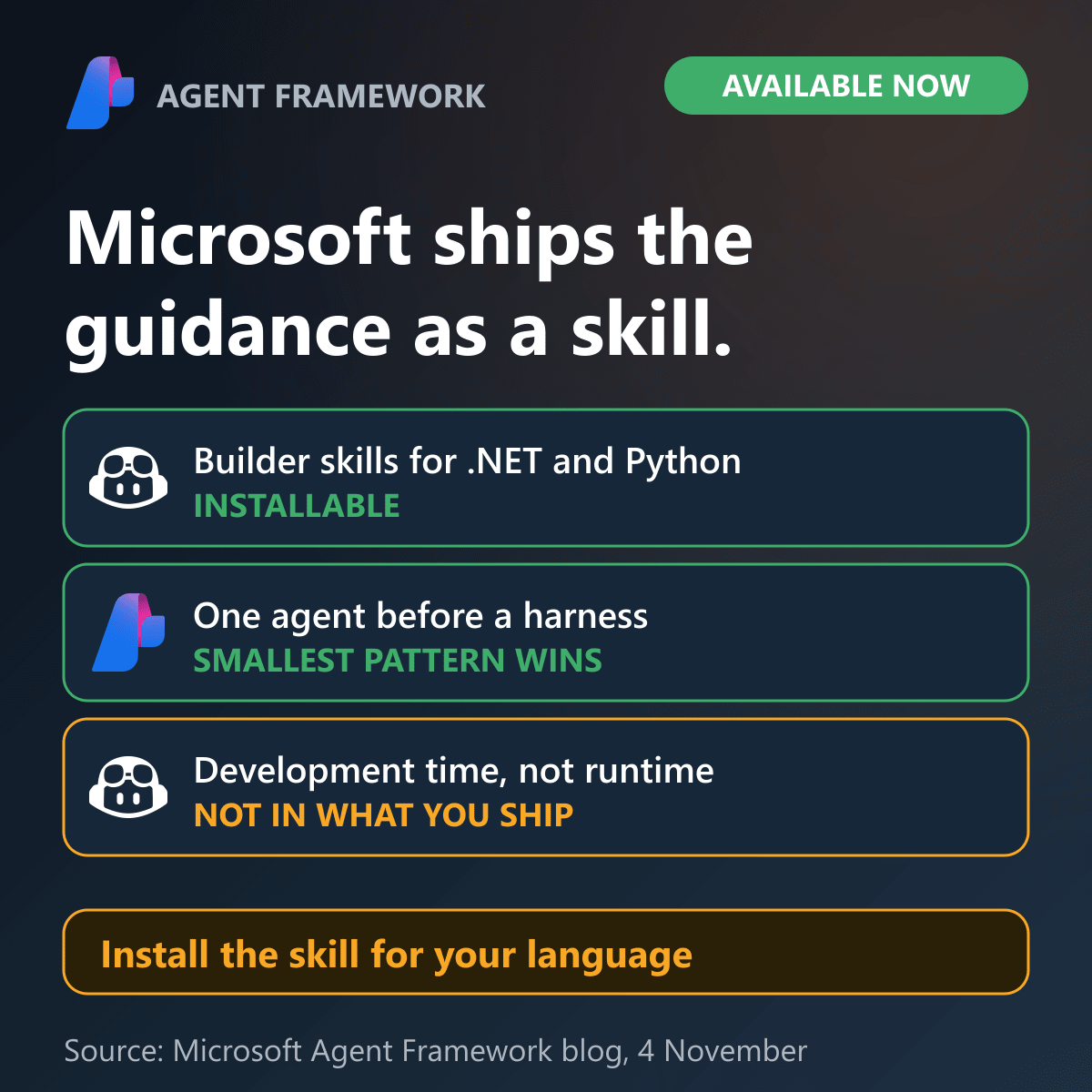
Agent Framework guidance installs as a skill
Microsoft published installable builder skills for .NET and Python, fetched with gh skill install or the cross-agent npx skills add. They follow the Agent Skills format and argue for the smallest pattern that works: one agent before a harness, a harness before a workflow. They run at development time, in your coding assistant, not inside what you ship.
Why it matters
Most agent code I review reaches for a multi-agent design far too early. Guidance arguing for less is worth installing. Pin a tag rather than main for reproducibility.
2Proof, and a local option
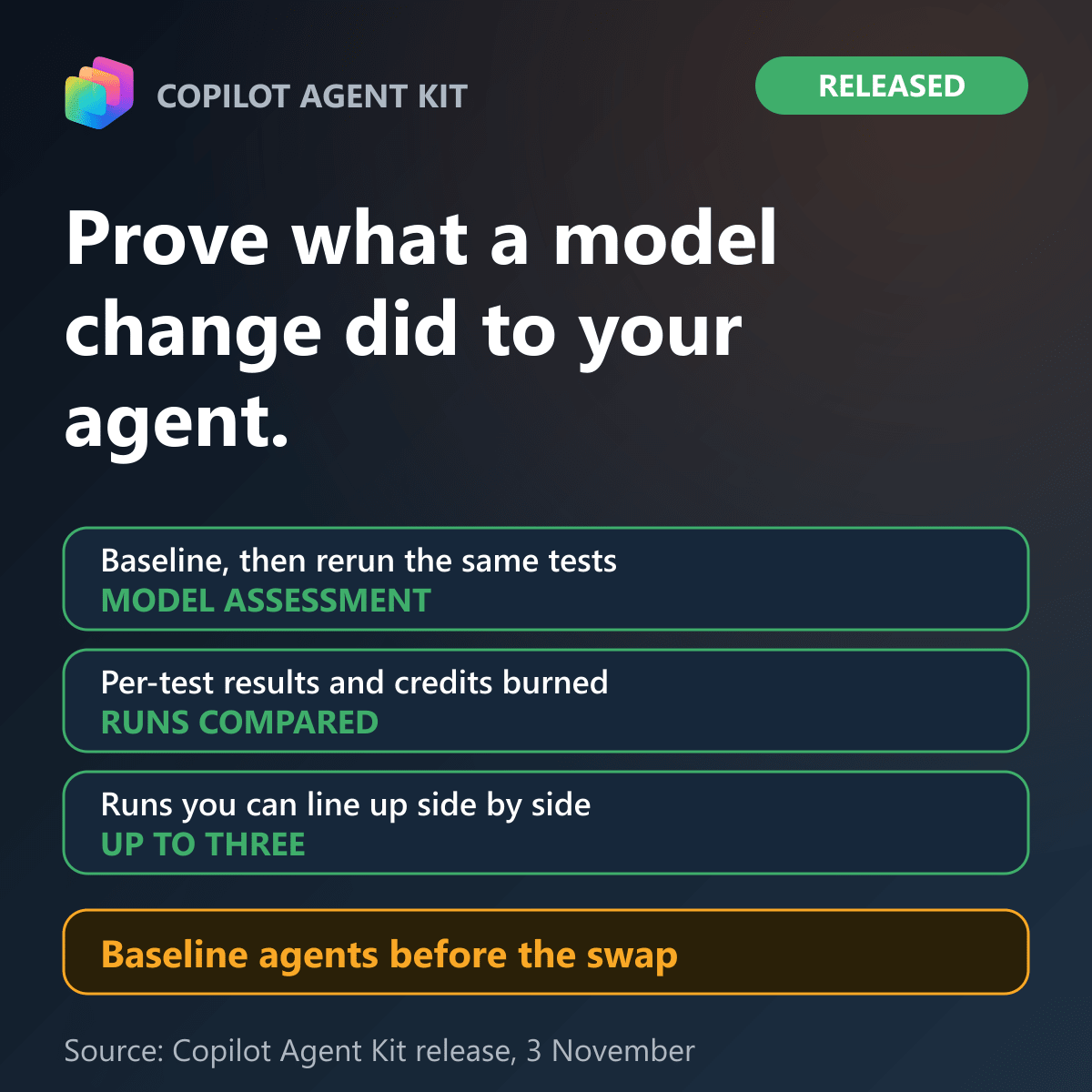
You can finally prove what a model change did
The Power CAT kit, now the Copilot Agent Kit, added Model Assessment in its 3 November release. It baselines the agent as it runs today, notices when the model changes, and reruns the same tests. Each run returns Healthy, Warning or Critical with per-test results and the Copilot Credits it burned. Compare up to three runs.
Why it matters
A model shifts under a live agent and now you can show exactly what moved. I would baseline every client agent before the next swap, not after it.
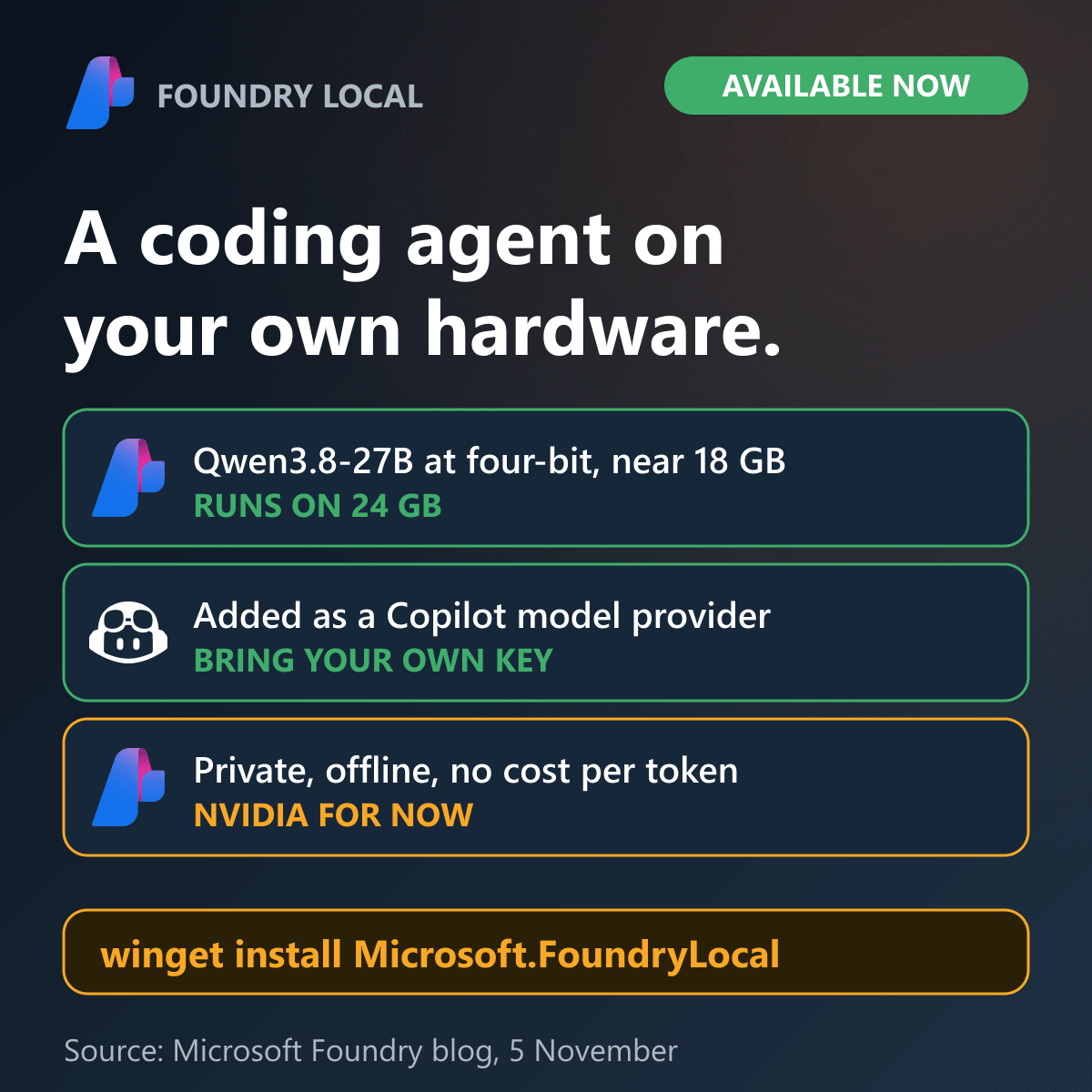
A coding agent that runs on your own hardware
Foundry Local 0.13 runs Qwen3.8-27B as a GitHub Copilot model provider over Bring Your Own Key. Four-bit quantisation brings it to roughly 18 GB, so a 24 GB consumer card runs it at a 64K token context, and 32 GB reaches the full 262K. Install with winget, then point the provider at the local endpoint. NVIDIA only for now.
Why it matters
Private, offline, no per-token cost for the everyday loop. Microsoft says the reasoning is weaker than a cloud model, which matches what I see locally.
3Also this week
- QuickCowork November release added a Planner plugin and OneNote reading, with page edits on your approval.
- QuickA new Work IQ path, /memory/me/coreMemories, will give authorised agents read-only access to a memory profile.
- QuickThe Entra November roundup actually covers October: agent identity guardrails are public preview, with a default inactivity policy in every tenant.
- QuickDynamics 365 Commerce exposes point of sale shift and cash management as Model Context Protocol tools.
- QuickThe Copilot Agent Kit review tool now covers Microsoft 365 declarative agent packages and custom skill files.
- QuickWork IQ recipes and federated connectors show an October preview and November general availability on the roadmap.
- QuickOffice in Copilot puts Word, Excel and PowerPoint editing inside the Microsoft Copilot app.
- QuickAgent Framework shipped Python 1.25.0 and .NET 1.28.0; Semantic Kernel shipped Python 1.47.0 and .NET 1.82.0.
Voices to follow
- Microsoft Software Engineer - CoworkBas Brekelmans
Software Engineer at Microsoft, started the Copilot Cowork project and previously CTO of Copilot Studio. The clearest voice on why Microsoft chose multi-model, MCP, and A2A architecture across the agent stack.
Microsoft Software Engineer, Cowork - ex-CTO Copilot Studio - Microsoft Cloud Developer Advocate - Copilot extensibilityPaolo Pialorsi
Cloud Developer Advocate at Microsoft for Microsoft 365 Copilot. He writes the developer-facing record of Work IQ and Copilot extensibility, including the retrieve tool that replaces hand-built search layers in agents.
Microsoft Cloud Developer Advocate - Copilot extensibility - Microsoft Principal Cloud Developer Advocate - AISeth Juarez
Principal Cloud Developer Advocate at Microsoft on AI. One of the most watchable explainers of Foundry, the Agent Framework, and GitHub Copilot for developers - deep technical content that stays accessible.
Microsoft Principal Cloud Developer Advocate - AI - Microsoft EVP - Copilot, Agents & PlatformCharles Lamanna
Executive Vice President for Copilot, Agents, and Platform at Microsoft. He owns the strategy behind Copilot Studio, Agent 365, and the Power Platform, so when the agent stack's direction shifts, it usually shifts because of a decision his org made.
Microsoft EVP - Copilot, Agents & Platform - Microsoft VP of Product - Copilot StudioJason Moore
Vice President of Product for Microsoft Copilot Studio, after 26 years at Microsoft on Windows, OneDrive and SharePoint. He announced agent accounts and business process memory, the shift that turns an agent into something an organisation staffs rather than prompts.
Microsoft VP of Product - Copilot Studio - Microsoft Partner Director - Foundry Agent ServiceJeff Hollan
Partner Director of Product at Microsoft, leading the Foundry agent platform: Agent Service, the Agent Framework, and the SDKs. The clearest source on how agents actually go from prototype to a hosted production runtime.
Microsoft Partner Director - Foundry Agent Service + Agent Framework - Microsoft Principal GPM - SharePoint & OneDriveKripal Kavi
Principal Group Product Manager at Microsoft, leading SharePoint and OneDrive experiences. He announced the Copilot-curated team knowledge base, which is where shared agent context is going to live for most organisations.
Microsoft Principal GPM - SharePoint & OneDrive - Microsoft Senior Software Engineer - Agent FrameworkEduard van Valkenburg
Senior Software Engineer on Microsoft's Agent Framework and Semantic Kernel for Python. He ships and documents the Python side of the framework, including the vector stores and context providers that agents use for retrieval.
Microsoft Senior Software Engineer - Agent Framework
Coming up
- 17 to 20 November 2026 · Microsoft Ignite, San Franciscothe Work IQ team promised roadmap detail there.
- Mid-November 2026 · Office in Copilot starts its worldwide rollout
- From 17 November 2026 · Intelligent call delegation moves from Frontier to public previewgeneral availability January 2027.
- Late November 2026 · Copilot connectors reach the Work IQ APIsexisting permissions unchanged.
- November 2026 · Work IQ recipes and federated connectors reach general availabilityper the roadmap.
- By 4 December 2026 · Power Platform Monitor adds Copilot Studio agent session success rate and alerts
This week's question
Runtime discovery means the SharePoint surface can change under a working agent with no version bump, and Microsoft explicitly says not to hard-code assumptions about it. I lean towards that being the right trade. I have not had a schema move mid-project yet. Have you?
Get Agentic Weekly in your inbox
Every Monday morning. Unsubscribe any time.