
On Wednesday 23 September, Microsoft Learn published a short post on The Skills Hub Blog: Changes to Microsoft Learn's public documentation repositories. Two minutes to read, and easy to miss if you don't follow that blog.
I wrote a short LinkedIn post about it on Saturday, and I described the docs repos as an open kitchen. You could watch the cooks change a recipe, send a plate back with an issue, or fix the seasoning yourself with a pull request. For most product documentation, that window closes by the end of December. The food still arrives. You just stop seeing the kitchen.
A LinkedIn post has room for the image and not much else. This is the long version: what the announcement says, what it doesn't say, and what I'm actually doing about it.
1. What Microsoft actually announced
The post is short, so it is worth reading the exact words rather than a summary. The opening line:
"Over the coming months, Microsoft Learn will retire most public repositories associated with product documentation."
Then the guiding principle: documentation repositories associated with open-source products, projects or communities are expected to remain open to public contributions. And the scope: this only covers Microsoft Learn documentation repositories. Product source code repos and sample code repos are not affected.
How a repo gets picked: Microsoft Learn evaluates each one on contribution activity, community engagement, business needs and operational dependencies. And what retirement means:
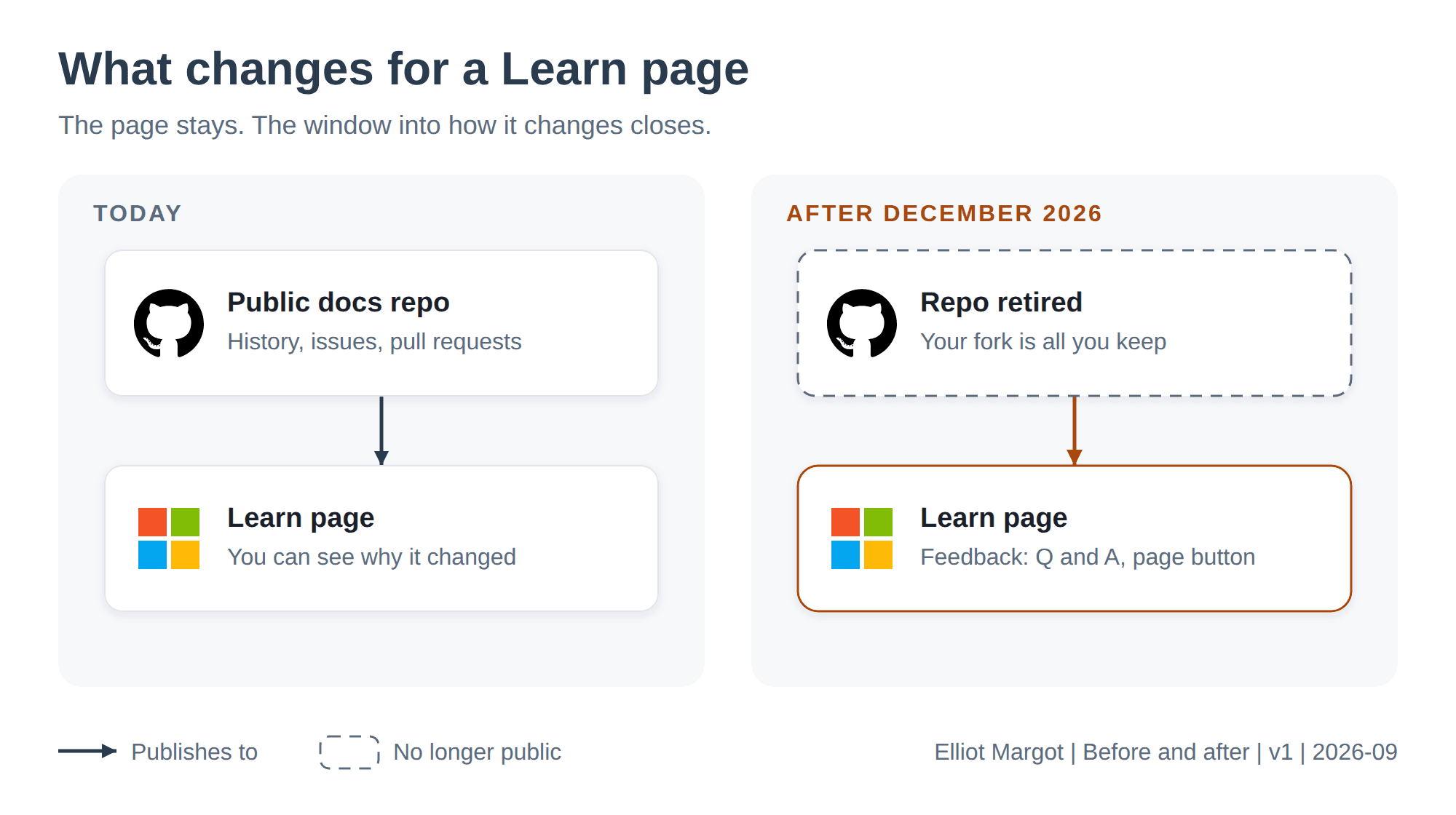
"Members of the public will no longer be able to view Microsoft's repository history, pull requests, or issues. Personal forks will still be accessible."
Retirement has already started with repos that have "smaller footprints", and Microsoft expects to retire the relevant repositories by the end of December 2026. Open pull requests and issues get evaluated through the existing process before a repo retires, and contributors hear about it through GitHub comments on their own PR or issue.
2. What goes and what stays
The honest summary is that nothing changes for someone who only reads Learn pages. Everything changes for someone who used the repo around the page. Side by side, for a product-docs repo that retires:
| Public docs repo today | After it retires | |
|---|---|---|
| Reading the Learn page | Yes | Yes, unchanged |
| Seeing what changed and when (commit history) | Public, line by line | Gone for the public |
| Proposing a fix (pull request) | Anyone with a GitHub account | No public repo to open one against |
| Reporting a problem | A GitHub issue: public, threaded, you can follow it | The page feedback button: anonymous, private, 999 characters, no reply |
| Asking a question | Microsoft Q&A, forums | Microsoft Q&A, forums |
| Your own fork | Yours | Still accessible |
The feedback row is the one I keep coming back to. Learn's own feedback page describes the standard experience: a thumbs up or down, an optional comment of up to 999 characters, anonymous, not publicly visible, and then this line, which I respect for its honesty:
"You won't receive a response after you submit your feedback."
That is a perfectly reasonable channel for "this sentence has a typo". It is a very different thing from an issue where you, the writer and three other people who hit the same problem can see each other and the fix.
3. The part the announcement doesn't list: history as a changelog
The post talks about contributors, and that makes sense: it was written for people with open pull requests. But I think the bigger group affected is people who never opened a pull request in their life.
If you deliver Copilot Studio or Power Platform projects, you know the moment. A page you read in March now says something slightly different. A limit moved, a prerequisite appeared, a step got reordered. The Learn page shows you a date. It doesn't show you what changed. For repos that were public, the commit history did: one click on History and you could see the exact lines, the day they changed, and often the reason in the commit message.
That is the kitchen window. It was never marketed as a feature, and it was one of the most useful things about Learn for anyone who has to explain to a client why last quarter's design no longer matches the docs.
4. Which repos are on the list? Nobody has said
The announcement names no repositories, and I haven't found a list anywhere else. So I'm not going to guess in public which ones go. What you can do is find out which repo a page you rely on lives in, because every Learn page says so in its HTML metadata. Two tags matter: original_content_git_url, which often points at a private repo ending in -pr, and github_feedback_content_git_url, which points at the repo the public can see.
curl -s https://learn.microsoft.com/en-us/power-automate/getting-started \
  | grep -oE '(name|property)="[a-z_]*git_url[a-z_]*" content="[^"]*"'

# name="original_content_git_url"
#   content="https://github.com/MicrosoftDocs/power-automate-docs-pr/blob/live/articles/getting-started.md"
# name="github_feedback_content_git_url"
#   content="https://github.com/MicrosoftDocs/power-automate-docs/blob/main/articles/getting-started.md"
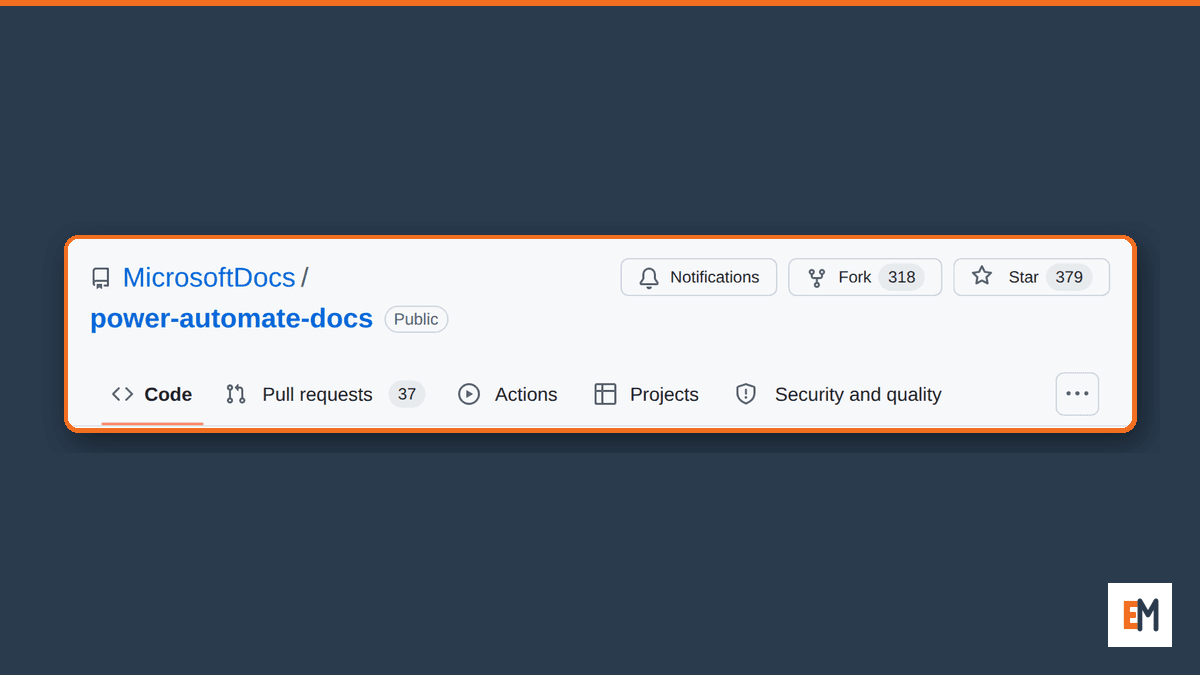
I ran that on two pages on 26 September 2026. The Power Automate getting-started page names a public repo, MicrosoftDocs/power-automate-docs, which was still public that day (318 forks, 379 stars, 37 open pull requests on its GitHub header). The Copilot Studio overview page names only businessapps-copilot-docs-pr in both tags, a private repo, so there is no public history there for the public to lose.
From there, the logic Microsoft gave is simple enough to draw:
5. Forks: the archive now lives with whoever forked
"Personal forks will still be accessible" is the most practical sentence in the post. A fork carries the full commit history up to the moment you made it, so the record of what changed and when survives in every fork that exists before the retirement.
The announcement doesn't say whether retiring means deleting a repo or making it private, and on GitHub those behave differently. GitHub's own documentation puts it this way: when a public repo is deleted, "An active public fork becomes the new upstream repository for the network." When a public repo is made private, "Its public forks stay public in a separate network." Either way the fork survives. What it won't do is keep moving: after the upstream goes dark, your fork is a snapshot, and every later change to the docs happens somewhere you can't see.
6. The docs haven't caught up with the announcement
A small thing, but it tells you how new this is. Learn's feedback page still tells readers they can see an article's change history and contributors through the Edit pencil and then History. For a retired repo, that stops being true for the public. And Learn's contributor guide still says that "Contributions to Microsoft Learn count toward MVP award consideration." As an MVP, I'd like to know what that means once most product-docs repos no longer take public contributions. The announcement doesn't say, so I won't either.
There is one signal on the page itself worth knowing. Learn's guide to editing in the browser says: "If the Edit pencil icon isn't present, it means the content isn't open to public contributions." Whether retired repos lose the pencil hasn't been confirmed yet, but it is the first place I'll look.
7. What I'm doing before December
This week gave me a reason to take this personally. I'd been building an ROI dashboard by hand for clients, and then found out the team that makes the product had already published one, free, on GitHub. It just wasn't on the Learn page where I'd looked. My new rule was going to be "the docs page is never the whole map". It lasted until I read Wednesday's post from Microsoft Learn, a day later.
So, plainly, here is what I'm doing:
- Checking where the pages I rely on live. The command above, on the Power Platform and Copilot Studio pages I send clients to. The Copilot Studio pages I checked already point at a private repo, so the list is shorter than I expected.
- Forking the public ones I actually use the history of. Power Automate docs is first on my list. It costs nothing and it keeps the record up to the day I fork it.
- Moving questions to Microsoft Q&A. When something in the docs needs a public answer, that is now the channel where other people can see it too. The feedback button is for typos.
- Not guessing the list. When Microsoft or the repos themselves say which ones retire, I'll update this post.
I understand why Microsoft is doing this. Running a large number of public repos with open pull requests from strangers is real work, and a smaller set of well-kept ones is a defensible choice. I'd still rather the window stayed open. For now I'm keeping mine open, with a fork, to see how it develops.
Sources: the Skills Hub Blog announcement (posted 23 Sep 2026, updated 24 Sep 2026), Provide feedback on Microsoft Learn, the Learn contributor guide, Edit Microsoft Learn documentation in the browser, and GitHub Docs on forks. Page metadata and repo status checked on 26 September 2026.
