
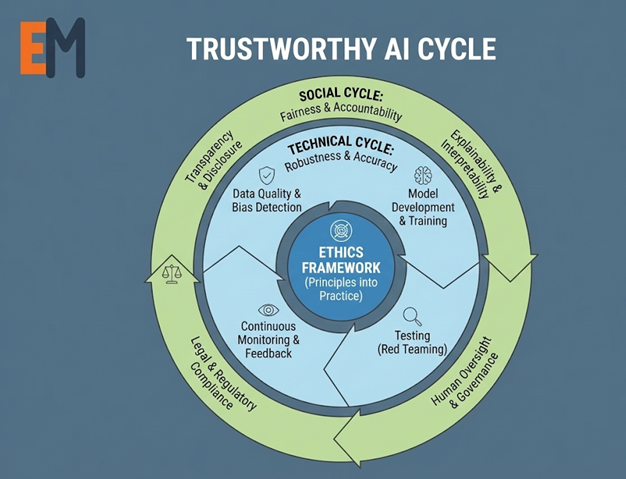
Trustworthy AI Cycle: Operationalizing Ethics
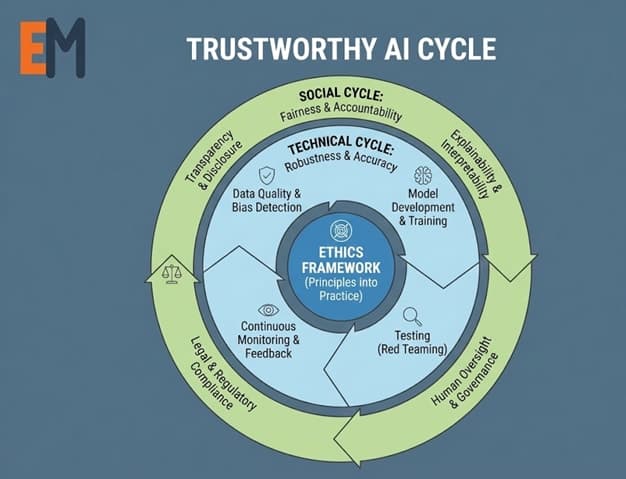
A structured framework for mitigating AI risks through a cyclical process of ethics, technical robustness, and social accountability.
Project details
The Operational Risk of AI
We often hear about the risks of AI—biased algorithms, unexplainable outputs, and a lack of accountability. These aren't just theoretical problems; they are operational risks that can lead to reputational damage and regulatory fines. To mitigate these risks, we aren't just relying on good intentions; we use a structured, cyclical process to bake ethics directly into the engineering lifecycle.
1. The Core Ethics Framework
Before a single line of code is written or a dataset is queried, we establish the guiding principles. This is the nucleus of the project. It involves defining what concepts like 'Fairness' actually mean in the specific mathematical context of the use case.
- Value Alignment: Does this model align with the company's core values?
- Beneficence: Does the model provide a tangible benefit to the user, or is it purely for data extraction?
- Fairness Metrics: We explicitly define which fairness metric to optimize for (e.g., Demographic Parity vs. Equal Opportunity), acknowledging that optimizing for one often trades off against another.
2. The Technical Cycle (Robustness & Accuracy)
This phase turns principles into engineering tasks. It is an iterative loop that occurs during development and training.
Rigorous Red Teaming
We don't just test if the model works; we try to make it fail. Red Teaming involves adversarial testing where engineers attempt to 'jailbreak' the model, force it to produce toxic content, or reveal private data. This stress-testing is essential for robustness.
- Data Quality & Bias Detection: We use tools like Great Expectations to validate data schemas and custom scripts to detect representation imbalances in training datasets before modeling begins.
- Model Robustness: Ensuring the model performs consistently across different subgroups and edge cases.
- Continuous Monitoring: Once deployed, we monitor for Data Drift (input data changing over time) and Concept Drift (the relationship between input and output changing), ensuring the model doesn't degrade.
3. The Social Cycle (Fairness & Accountability)
Technology does not exist in a vacuum. This outer ring ensures the AI serves its human users and adheres to legal standards.
- Explainability (XAI): We prioritize models that can explain why a decision was made. For black-box models, we use SHAP (SHapley Additive exPlanations) values to show which features contributed most to a specific prediction.
- Human Oversight (HITL): For high-stakes decisions (like loan approvals or medical diagnosis), the AI never has the final say. It acts as a recommender system for a human expert who makes the final judgment.
- Transparency: Users are always informed when they are interacting with an AI.
Scenario: The Cycle in Action
Imagine we are building an AI Resume Screener. Here is how the cycle prevents a disaster:
- Ethics Core: We decide that 'school name' should not influence the ranking to prevent elitist bias.
- Technical Cycle: During Red Teaming, engineers notice the model is correlating 'lacrosse' (a sport) with higher rankings. We adjust the dataset to remove proxy variables for wealth.
- Social Cycle: We implement a 'Why this rank?' dashboard for HR managers (Explainability) and ensure no candidate is rejected without a human review (Oversight).
“We cannot proceed to modeling until the data quality step satisfies our ethical framework.”